
See how Prep4All works
A 5-minute film for parents
The Prep4All library
Every resource, with short videos
Lessons
Structured lessons & exercises — free samples
Fun Lessons
Interactive & engaging lessons
Vocabulary
Build your word power
Creative Writing
Prompts, techniques & games
Comprehension
Passages, skills & mock papers
Flash Cards
Quick revision cards
Knowledge Nuggets
Bite-sized learning tips
11+ Syllabus Hub
Every topic & question type explained
11+ Subjects
Explore all subjects
Grammar Schools
School guides & information
Find Schools Near You
Nearest grammar schools by postcode
11+ Key Dates
Registration, test & apply-by dates
11+ Pass Marks
Qualifying scores by county
Readiness Quiz
Is your child ready? 2-min check
11+ Prep Guide
Complete preparation guide
FSCE Hub
Complete FSCE syllabus, schools & practice
FSCE Exam Guide
Exam preparation guide
ISEB Pre-Test Hub
Format, scoring, sections & preparation
ISEB Exam Guide
The Pre-Test explained for parents
ISEB Schools
Which schools use the Pre-Test — verified
Blog
Articles & expert tips
Contact Us
Get in touch with us
Join WhatsApp
Join our community group
Synonyms and Antonyms
Synonyms and Antonyms
Some words are best friends that mean almost the same thing; others are sworn enemies that mean the opposite. In Verbal Reasoning a synonym is a word with the same meaning, and an antonym is a word with the opposite meaning. The catch at 11+ level? The words get tricky — so this lesson also gives you a method for cracking ones you have never seen.
In this lesson you'll learn:
- What synonyms and antonyms are
- How to handle hard or unfamiliar words using prefixes and roots
- The sneaky "related but not the same" traps
- The exact ways they appear in the exam
Synonyms vs Antonyms
A synonym means the same (or nearly): generous and benevolent, brave and valiant, begin and commence. An antonym means the opposite: abundant and scarce, praise and criticise, expand and contract.
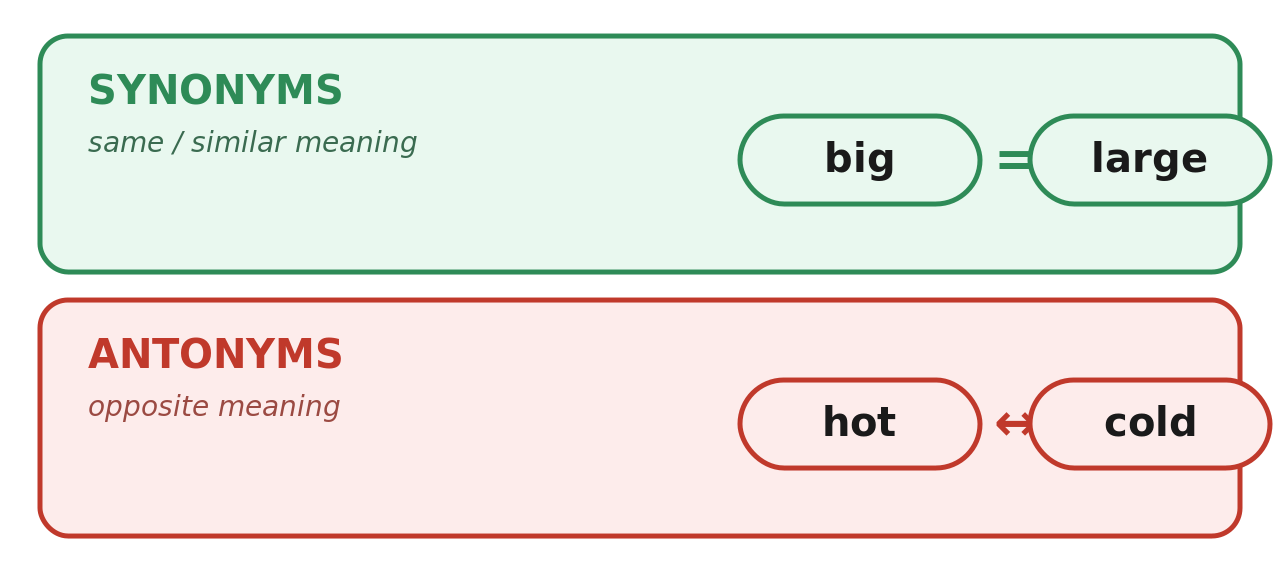
Memory trick: Antonym = Against (opposite); a synonym is the "same" one.
Notice the examples are not baby words. At 11+, expect grown-up vocabulary like benevolent, scarce or commence — so here is how to handle words you do not know.
Cracking Words You Don't Know
You will not know every word — but you can often work it out from its parts.
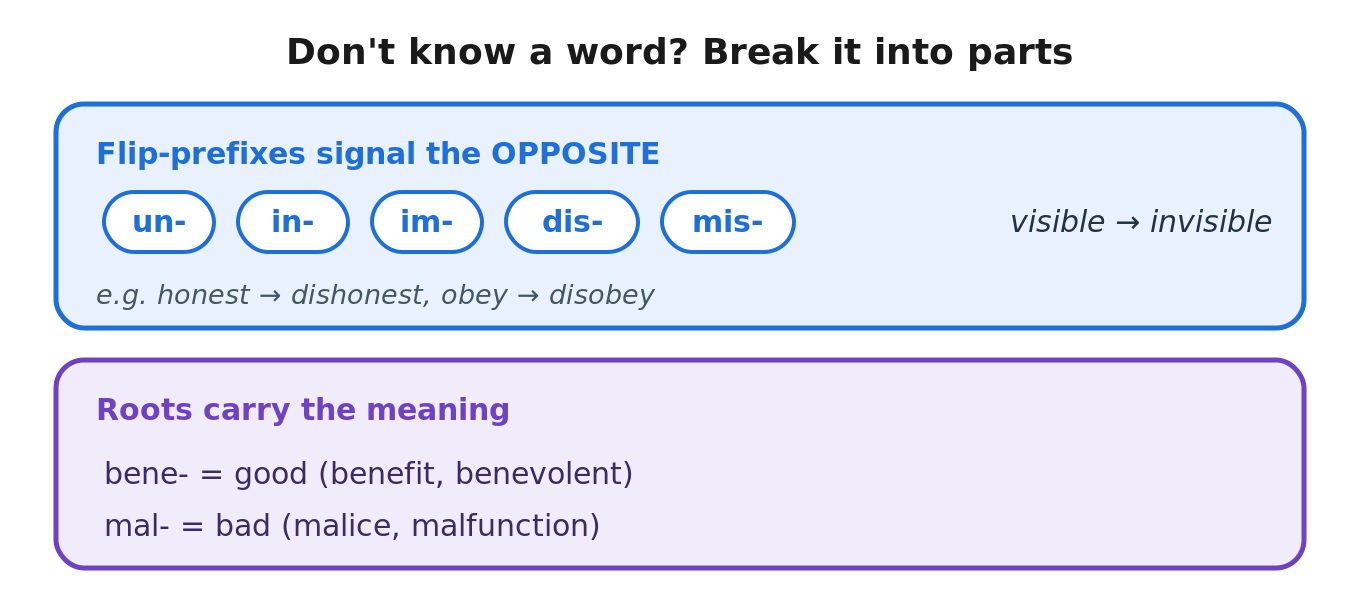
- Flip-prefixes point to the opposite: un-, in-, im-, dis-, mis-. If visible means "can be seen", then invisible is its antonym; honest becomes dishonest. Spotting a flip-prefix is a shortcut to the antonym.
- Roots carry the meaning: bene- means good (benefit, benevolent); mal- means bad (malice, malfunction). See bene- and you know the word is something positive.
- Read it in a sentence: many words have more than one meaning. "The bag was light" (opposite: heavy) versus "Switch on the light" (opposite: dark). Context decides the answer.
Top exam tip: Stuck on a word? Don't panic — break it into a prefix and a root, or slot it into a sentence. You can often reason your way to the answer without ever having met the word.
Watch Out for "Related" Traps
Examiners love offering a word from the same topic that is not a true synonym or antonym.
For summon (meaning "to call for"), a question might tempt you with shout, phone or arrive — all "calling-ish" — but the real synonym is call. The test: a true synonym is swappable — put it in the sentence and the meaning must stay the same.
Tricky trap! "Connected to the word" is not "means the word". Bark is connected to dog, but it is not a synonym for it.
In the Exam
Synonym and antonym questions appear in a few set formats — learn to spot them:
- Closest in meaning: "Which word means the same as frugal?" gives the synonym (thrifty).
- Opposite in meaning: "Which word is most opposite to abundant?" gives the antonym (scarce).
- Two groups (a common GL format): choose one word from each group that are closest (or most opposite) in meaning, e.g. (reluctant, eager, tired) and (keen, calm, slow) gives eager / keen.
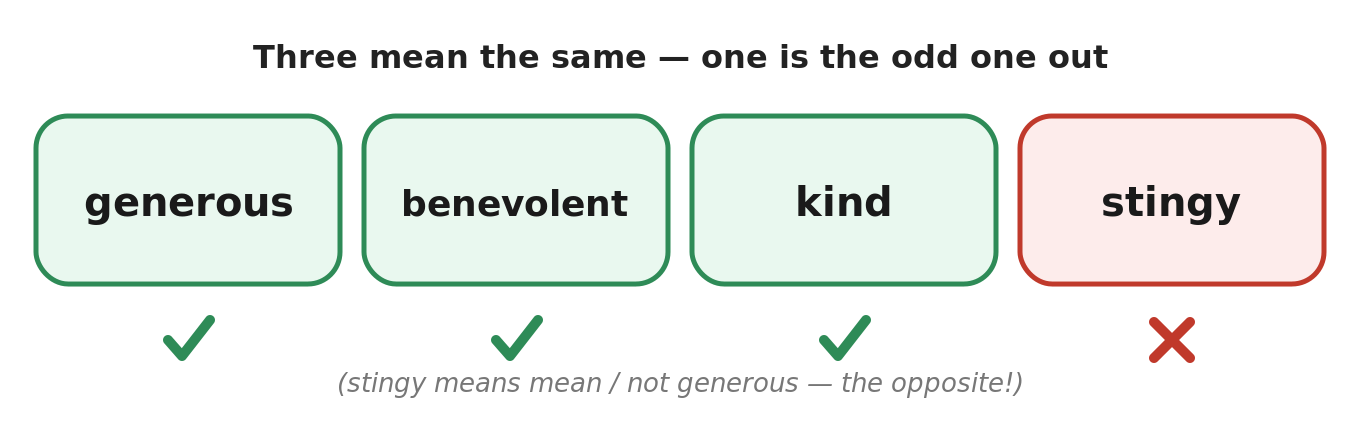
- Odd one out: three words share a meaning; one does not.
Your Turn: Two Exam-Level Examples
Example 1 (synonym). Which word means the same as RELUCTANT? — eager, unwilling, cheerful, curious
- Meaning? Reluctant means not wanting to do something.
- Use the clue. The flip-prefix un- turns willing into "not willing" — which matches "not wanting".
- Answer: unwilling.
Example 2 (antonym). Which word is the opposite of GENEROUS? — kind, wealthy, selfish, gentle
- Meaning? Generous means happy to give.
- Spot the trap. Kind and gentle feel similar to generous — but we need the opposite; wealthy is about money, not giving.
- Answer: selfish, the opposite of giving.
Quick Recap
- Synonym = same meaning; antonym = opposite. Expect hard, grown-up words at 11+.
- Stuck? Use the parts: flip-prefixes (un-, dis-, im-) point to antonyms; roots (bene- = good, mal- = bad) give meaning.
- Read it in a sentence — context picks the right meaning.
- A true synonym is swappable; beware merely "related" words.
- Know the formats: closest-meaning, opposite-meaning, two-groups, and odd-one-out.
Now you can crack even the trickiest word pairs — and that is where the real marks are! Head to the exercises and give them a go!
Enjoyed this lesson? There's a whole library waiting.
Subscribers get every lesson plus built-in practice exercises with instant marking and progress tracking.