
See how Prep4All works
A 5-minute film for parents
The Prep4All library
Every resource, with short videos
Lessons
Structured lessons & exercises — free samples
Fun Lessons
Interactive & engaging lessons
Vocabulary
Build your word power
Creative Writing
Prompts, techniques & games
Comprehension
Passages, skills & mock papers
Flash Cards
Quick revision cards
Knowledge Nuggets
Bite-sized learning tips
11+ Syllabus Hub
Every topic & question type explained
11+ Subjects
Explore all subjects
Grammar Schools
School guides & information
Find Schools Near You
Nearest grammar schools by postcode
11+ Key Dates
Registration, test & apply-by dates
11+ Pass Marks
Qualifying scores by county
Readiness Quiz
Is your child ready? 2-min check
11+ Prep Guide
Complete preparation guide
FSCE Hub
Complete FSCE syllabus, schools & practice
FSCE Exam Guide
Exam preparation guide
ISEB Pre-Test Hub
Format, scoring, sections & preparation
ISEB Exam Guide
The Pre-Test explained for parents
ISEB Schools
Which schools use the Pre-Test — verified
Blog
Articles & expert tips
Contact Us
Get in touch with us
Join WhatsApp
Join our community group
Symmetry
Symmetry
Get ready to become a symmetry detective! Symmetry is hiding everywhere — in butterflies, snowflakes, football badges, even your own face. Once you can spot it, those Non-Verbal Reasoning questions turn into quick, easy marks. Let's go!
There are two types of symmetry to master:
- Line symmetry — the mirror kind
- Rotational symmetry — the spinning kind
Line Symmetry: The Mirror Test
A shape has line symmetry if you can draw a straight line through it so that one half is a perfect mirror image of the other. That line is called the line of symmetry (or the mirror line).
Here's the easiest test ever: imagine folding the shape along the line, like folding a piece of paper. If the two halves land exactly on top of each other — snap! — it's a line of symmetry.
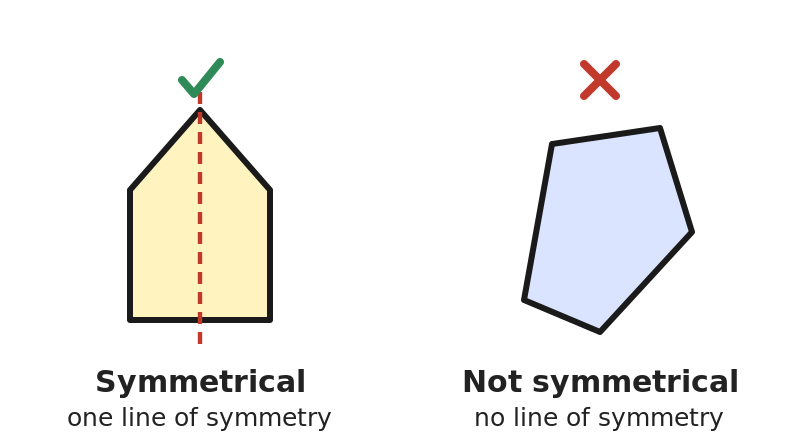
The shape on the left folds in half perfectly, so it's symmetrical. The wonky shape on the right just won't match, however you fold it — so it has no line of symmetry.
Did you know? A butterfly is a perfect example of line symmetry — its left wing is a mirror image of its right wing. So is (almost!) every human face.
How Many Lines Can a Shape Have?
Some shapes are real show-offs and have lots of lines of symmetry! Here's a handy rule: a regular shape (all sides and angles equal) has the same number of lines of symmetry as it has sides. A square has 4 sides, so it has 4 lines. Neat!
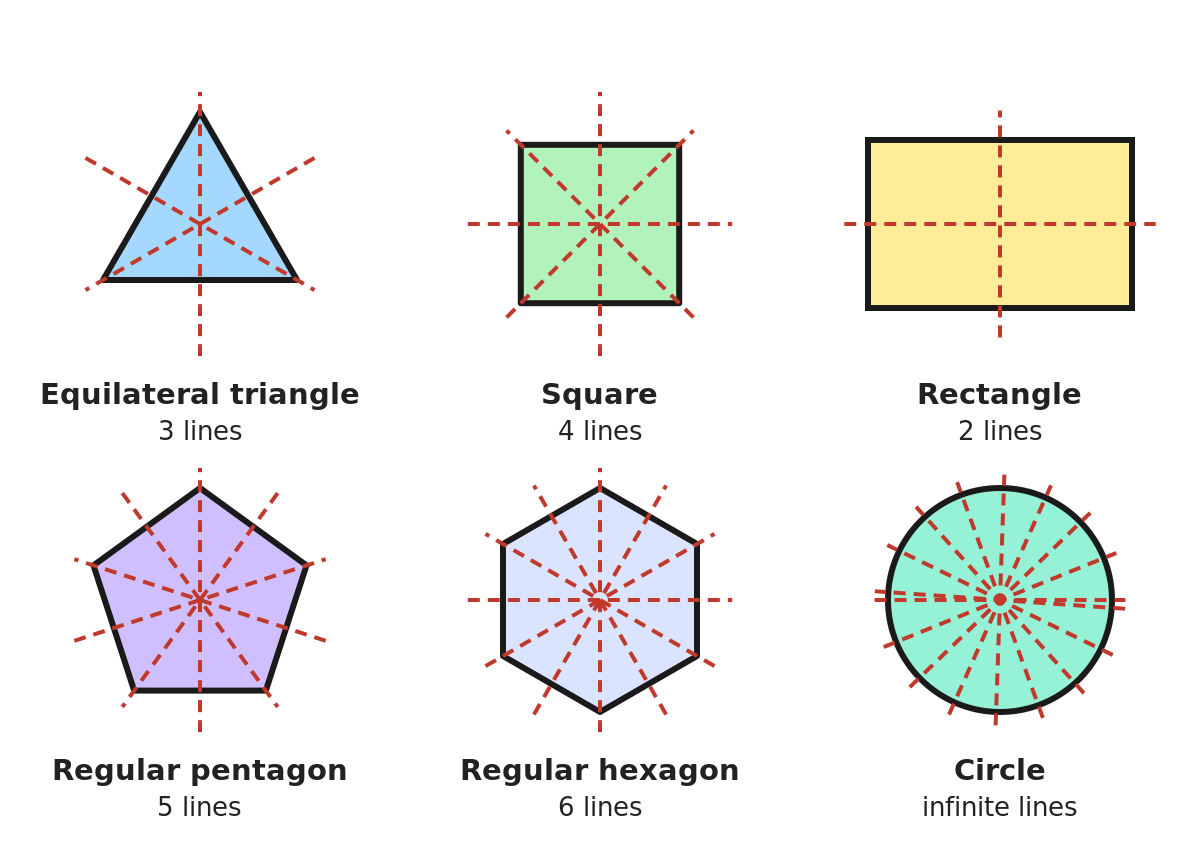
Pop these into your memory bank:
- Equilateral triangle → 3 lines
- Square → 4 lines
- Rectangle → 2 lines (just up–down and left–right — the diagonals are sneaky imposters!)
- Regular pentagon → 5 lines
- Regular hexagon → 6 lines
- Circle → infinitely many!
Tricky trap! A rectangle is not a square. If you fold a rectangle along its diagonal, the corners miss each other — so a diagonal is not a line of symmetry.
Mirror Lines Love to Tilt
A line of symmetry doesn't have to go straight up and down. It can be vertical, horizontal, or diagonal — and some shapes have lines pointing every which way!
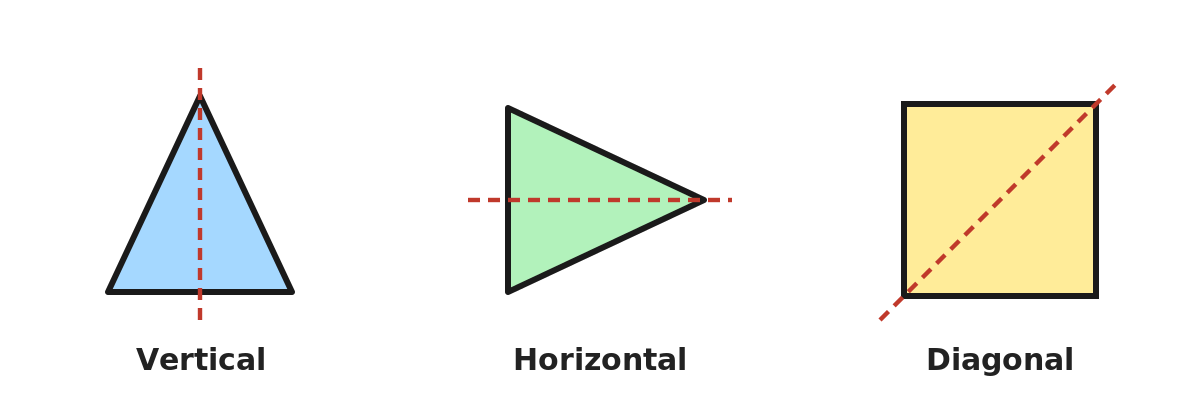
Top exam tip: Lots of pupils check only for an up-and-down mirror line and miss the rest. Always look sideways and diagonally too. Stuck on a diagonal one? Tilt your head (or turn the page) so it becomes vertical — much easier to spot!
Rotational Symmetry: The Spin
Time to spin! A shape has rotational symmetry if it looks exactly the same after you turn it part of the way around — without flipping it over.
The order of rotational symmetry is just a clever way of asking: how many times does it look the same in one full spin?
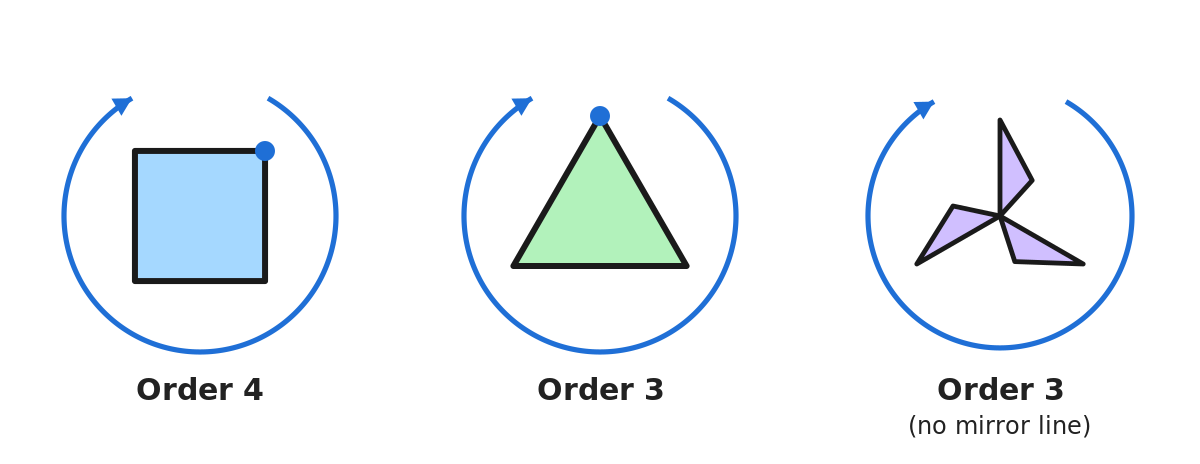
- A square looks the same 4 times as it spins all the way round → order 4 (a quarter turn each time).
- An equilateral triangle → order 3.
- The pinwheel spins to look the same 3 times too → order 3 — but look closely: it has no mirror line at all! A shape can spin-match without being a mirror-match.
Spot it in real life: A fidget spinner is usually order 3. So is the recycling symbol! Many car wheel hubcaps are order 5.
In the Exam
Symmetry questions usually turn up in these styles:
- Which shape has a line of symmetry? → use the fold test on each option.
- How many lines of symmetry? → count carefully: up–down, side–side and diagonal.
- Complete the symmetrical figure → reflect the pattern across the mirror line.
- Which is the mirror image? → the answer is flipped, not turned.
Your Turn: Complete the Pattern
The left half of this pattern is given, with a mirror line down the middle. To finish it, reflect every shaded square across the line — pretend the line really is a mirror!
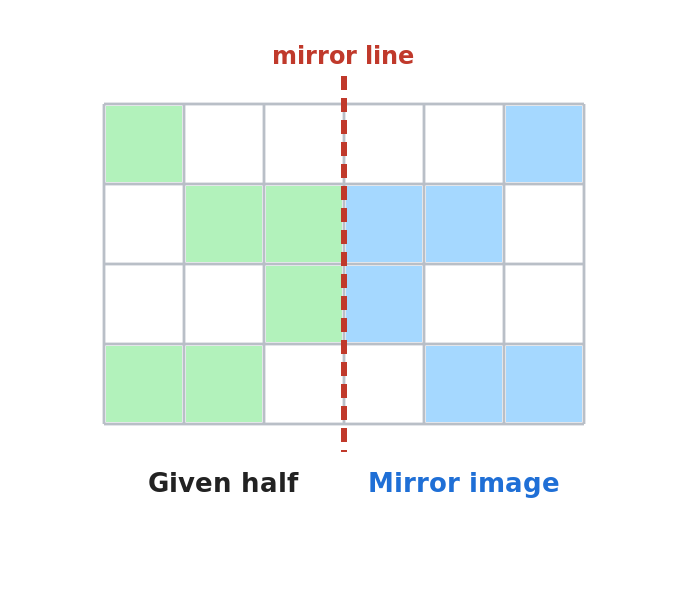
The trick: a square 1 step to the left of the line needs a partner 1 step to the right. A square 3 steps away matches one 3 steps away on the other side. Count the steps, copy it across — and you'll get it right every time.
Quick Recap
- Line symmetry: one half mirrors the other — use the fold test.
- Count all the lines: vertical, horizontal and diagonal.
- A regular shape has as many lines of symmetry as it has sides.
- Rotational symmetry: it matches itself as it spins; the order = how many times in one full turn.
- For "complete the figure": count each square's steps from the mirror line and copy them across.
You're now a fully qualified symmetry detective! Go and try the exercises — you've got this!
Enjoyed this lesson? There's a whole library waiting.
Subscribers get every lesson plus built-in practice exercises with instant marking and progress tracking.