
See how Prep4All works
A 5-minute film for parents
The Prep4All library
Every resource, with short videos
Lessons
Structured lessons & exercises — free samples
Fun Lessons
Interactive & engaging lessons
Vocabulary
Build your word power
Creative Writing
Prompts, techniques & games
Comprehension
Passages, skills & mock papers
Flash Cards
Quick revision cards
Knowledge Nuggets
Bite-sized learning tips
11+ Syllabus Hub
Every topic & question type explained
11+ Subjects
Explore all subjects
Grammar Schools
School guides & information
Find Schools Near You
Nearest grammar schools by postcode
11+ Key Dates
Registration, test & apply-by dates
11+ Pass Marks
Qualifying scores by county
Readiness Quiz
Is your child ready? 2-min check
11+ Prep Guide
Complete preparation guide
FSCE Hub
Complete FSCE syllabus, schools & practice
FSCE Exam Guide
Exam preparation guide
ISEB Pre-Test Hub
Format, scoring, sections & preparation
ISEB Exam Guide
The Pre-Test explained for parents
ISEB Schools
Which schools use the Pre-Test — verified
Blog
Articles & expert tips
Contact Us
Get in touch with us
Join WhatsApp
Join our community group
Reflection
Reflection
Ever waved at yourself in a mirror? Your reflection waves back — but with the opposite hand! That is exactly what reflection does in Non-Verbal Reasoning: it flips a shape over a line to make a mirror image. Get the hang of it and you will spot the right answer in a flash. Let's dive in!
In this lesson you'll learn:
- What reflection does to a shape
- The "equal-distance" rule for getting it exactly right
- Mirrors that tilt — vertical, horizontal and diagonal
- The classic trap: reflection vs rotation
What Is Reflection?
A reflection flips a shape over a straight line called the mirror line (or line of reflection). The flipped shape is called the image.
Two things never change when you reflect a shape:
- The image is exactly the same size and shape as the original — reflecting never stretches or shrinks it.
- The image is flipped, like a mirror — whatever pointed left now points right.
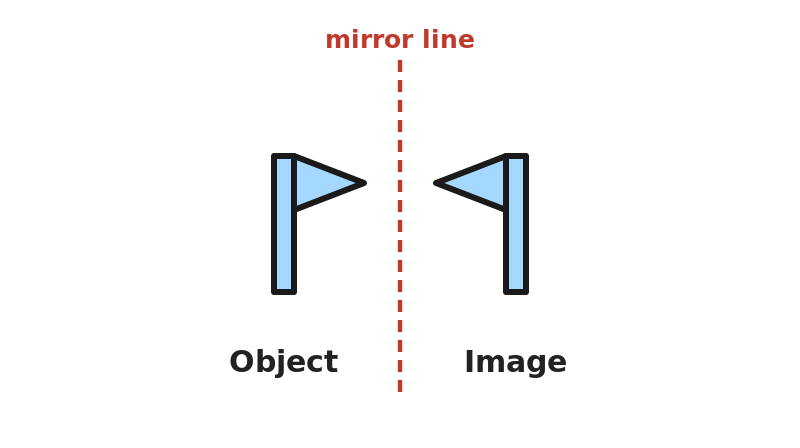
See how the flag "faces" the other way after the flip? It is the same flag, just mirrored.
Did you know? The word AMBULANCE is often written back-to-front on the front of the vehicle — so that when a driver sees it in their mirror, it reads the right way round!
The Equal-Distance Rule
Here is the secret to getting reflections perfect every time: every point of the image is the same distance from the mirror line as the original — just on the opposite side.
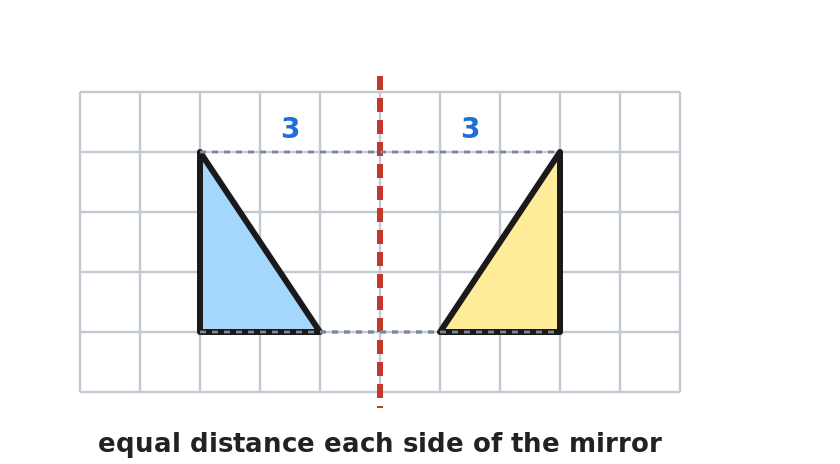
So if a corner is 3 squares to the left of the mirror, its reflection is 3 squares to the right. Measure, hop across the line, mark the same distance. Done!
Mirrors Can Tilt
Just like lines of symmetry, a mirror line can be vertical, horizontal, or diagonal. The shape always flips across whichever line you are given.
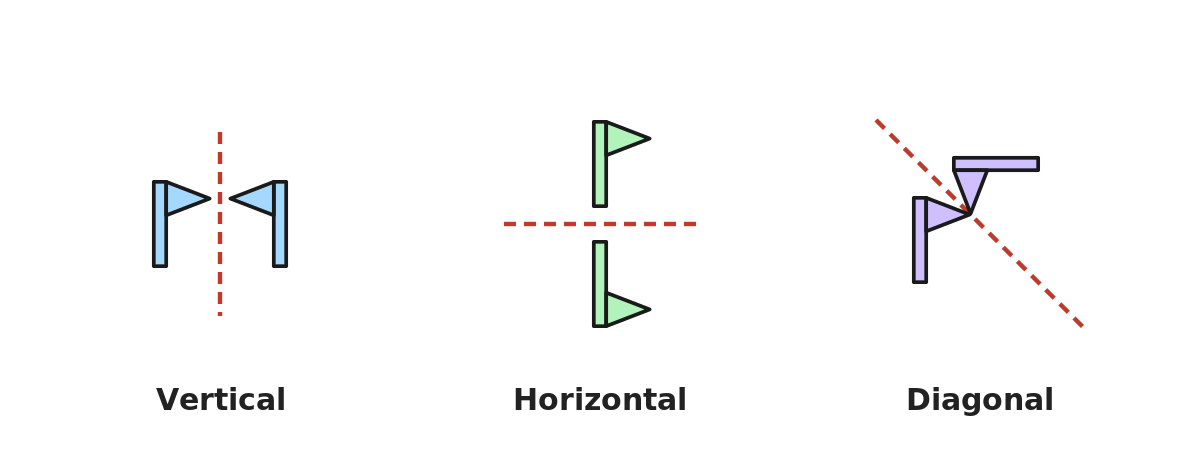
Top exam tip: A horizontal mirror flips the shape top-to-bottom; a vertical mirror flips it left-to-right. For a tricky diagonal mirror, tilt your head so the line stands upright — then it is just an ordinary flip.
Reflection vs Rotation — the Big Trap!
This is the one examiners love. A reflection flips a shape, so it comes out backwards, like a mirror. A rotation simply turns it — same shape, same way round, not flipped.
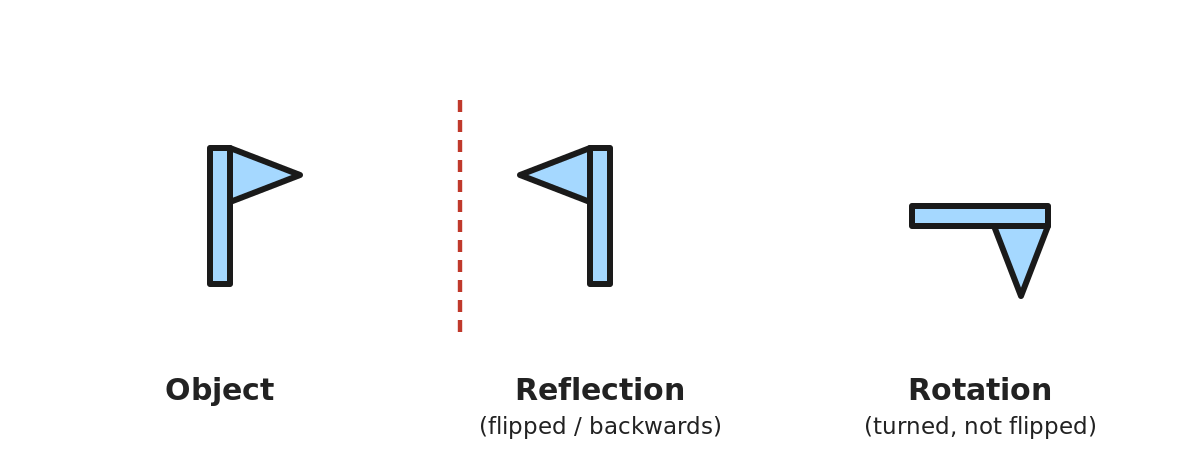
Look at the flag: the reflection is back-to-front, while the rotation is just spun round.
Tricky trap! If a shape has no symmetry (like a flag, or the letter R), its reflection looks backwards but a rotation does not. When an option looks "flipped", it is a reflection; when it looks "turned", it is a rotation.
In the Exam
Reflection questions usually look like this:
- Which shape is the reflection? → find the flipped, back-to-front version — not a turned one.
- Reflect this shape across the mirror line → use the equal-distance rule, corner by corner.
- Reflect in a vertical / horizontal / diagonal line → check which way the mirror points first.
Your Turn: Reflect the Shape
The shape on the left needs reflecting across the mirror line. Flip every shaded square to the other side, keeping each one the same distance from the line.
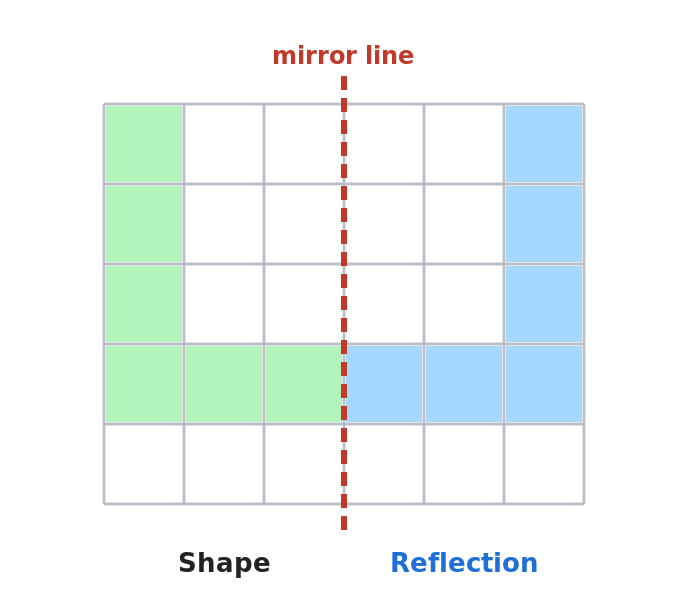
Work corner by corner: count the squares from the mirror, then count the same number on the other side. Line them all up and the mirror image appears!
Quick Recap
- Reflection flips a shape over a mirror line to make its image.
- Same size, just flipped — and every point is an equal distance either side of the line.
- Mirror lines can be vertical, horizontal or diagonal.
- Reflection flips (backwards); rotation turns (not flipped) — do not mix them up!
- To solve one: measure to the mirror, then the same distance across.
That's reflection sorted — you're seeing double now! Head to the exercises and give them a go!
Enjoyed this lesson? There's a whole library waiting.
Subscribers get every lesson plus built-in practice exercises with instant marking and progress tracking.