
See how Prep4All works
A 5-minute film for parents
The Prep4All library
Every resource, with short videos
Lessons
Structured lessons & exercises — free samples
Fun Lessons
Interactive & engaging lessons
Vocabulary
Build your word power
Creative Writing
Prompts, techniques & games
Comprehension
Passages, skills & mock papers
Flash Cards
Quick revision cards
Knowledge Nuggets
Bite-sized learning tips
11+ Syllabus Hub
Every topic & question type explained
11+ Subjects
Explore all subjects
Grammar Schools
School guides & information
Find Schools Near You
Nearest grammar schools by postcode
11+ Key Dates
Registration, test & apply-by dates
11+ Pass Marks
Qualifying scores by county
Readiness Quiz
Is your child ready? 2-min check
11+ Prep Guide
Complete preparation guide
FSCE Hub
Complete FSCE syllabus, schools & practice
FSCE Exam Guide
Exam preparation guide
ISEB Pre-Test Hub
Format, scoring, sections & preparation
ISEB Exam Guide
The Pre-Test explained for parents
ISEB Schools
Which schools use the Pre-Test — verified
Blog
Articles & expert tips
Contact Us
Get in touch with us
Join WhatsApp
Join our community group
LCM
Mathematics: Lowest Common Multiple (LCM)
What is LCM?
The Lowest Common Multiple (LCM) of two or more numbers is the smallest multiple that is exactly divisible by each of the numbers.
In simpler words, it’s the smallest number that appears in the multiplication tables of all the given numbers.
Why is LCM Important?
Finding the LCM is helpful in solving problems where you need things to "line up" or "match up," such as:
- Solving fraction problems
- Scheduling events or cycles
- Determining common intervals
Steps to Find the LCM
To find the LCM of two numbers, you can use these methods:
Method 1: Listing Multiples
- List the multiples of each number.
- Identify the smallest common multiple in both lists.
Example: Find the LCM of 3 and 4.
- Multiples of 3: 3, 6, 9, 12, 15, 18, …
- Multiples of 4: 4, 8, 12, 16, 20, 24, …
The smallest common multiple of 3 and 4 is 12.
So, LCM(3, 4) = 12
Method 2: Prime Factorization
- Write the prime factors of each number.
- Multiply each prime factor by the greatest number of times it appears in any factorization.
Example: Find the LCM of 8 and 12.
- Prime factors of 8 = 2 x 2 x 2
- Prime factors of 12 = 2 x 2 x 3
Use the highest number of times for each prime factor:
LCM = 2 x 2 x 2 x 3
So, LCM(8, 12) = 24.
Method 3: Division Method
- Write the numbers in a row.
- Divide by a common prime factor until all numbers are reduced to 1.
- The LCM is the product of all divisors used.
Example: Find the LCM of 6 and 9.
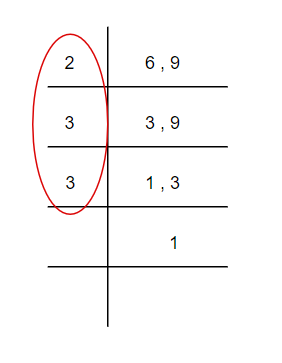
So, LCM(6, 9) = 2 x 3 x 3 = 18
Tips for Finding the LCM
- Use the listing method for small numbers; it’s quick and easy.
- Use prime factorization or the division method for larger numbers.
Enjoyed this lesson? There's a whole library waiting.
Subscribers get every lesson plus built-in practice exercises with instant marking and progress tracking.